
The Ultimate Guide to AEO: Beyond SEO in the Age of AI
Introduction: The End of the Ten Blue Links
Why AEO, For more than two decades, the game of digital marketing has been played on a simple, predictable field: the Google search engine results page (SERP). The rules were clear. Your goal was to be one of the “ten blue links.” You achieved this through Search Engine Optimization (SEO)—a complex dance of keywords, backlinks, and technical wizardry. The user would type a query, scan the links, and click. Your job was to get that click.
That era is over.
We have entered the age of Answer Engines.

Think about your own behavior. When you ask your phone, “What’s the weather?” you don’t get a link to a weather website. You get an answer: “It’s 72 degrees and sunny.” When you type, “How to tie a bow tie” into Google, you’re not just looking for a link; you’re looking for the video, the steps, the direct instructions that appear right on the page.
Now, generative AI has thrown gasoline on this fire.
Tools like ChatGPT, Perplexity, and Google’s own AI Overviews (formerly Search Generative Experience or SGE) are not “search engines.” They are synthesis engines. They crawl the web, ingest information from millions of sources (including your website), and then synthesize a brand new, direct answer for the user.
In this new world, the user may never click. They get their answer and leave. This is the “zero-click” apocalypse that marketers have feared, and it’s finally here.
But this isnt an apocalypse. It’s an evolution. And it presents a new, vital discipline: Answer Engine Optimization (AEO).
AEO is not a replacement for SEO. It is the necessary next layer. It is the strategic, technical, and content-based optimization of your information to ensure that your brand, your data, and your voice are the source for these new answer engines.
Your goal is no longer just to rank. Your goal is to be the cited authority for the answer.
This guide is your blueprint for navigating this new terrain. We will not be talking about “Devozy Marketing” or any other single agency, because this shift is bigger than any one company. This is a fundamental change in how humans access information.
We will cover:
- The Great Shift: A deep dive into the “why” behind the move from Search to Answers.
- AEO vs. SEO: A clear breakdown of their partnership and why you need both.
- The Four Pillars of AEO: The core framework for building your strategy (Intent, Content, Technical, and Trust).
- The AEO Battlefield: Practical tactics for optimizing for AI Overviews, Featured Snippets, “People Also Ask,” and Voice Search.
- Your 10-Step AEO Action Plan: A checklist to start implementing today.
Strap in. The web is changing, and your business must change with it.
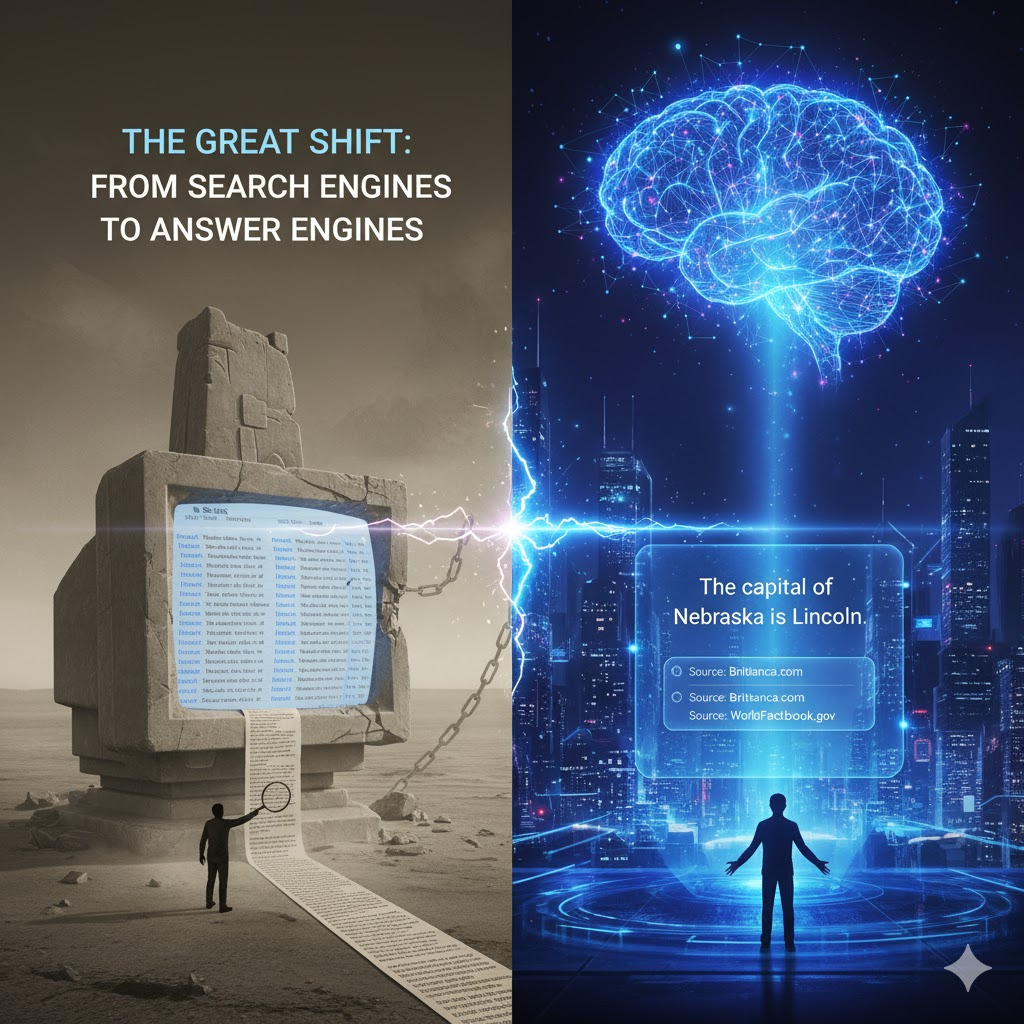
Chapter 1: The Great Shift: From Search Engines to Answer Engines
To win the new game, you must first understand the new rules. The transition from a “list of links” to a “direct answer” wasn’t a sudden event; it was a slow, deliberate progression.
The “Old” Web (The Age of SEO)
In the beginning, Google was a librarian. You’d ask it for “books on dog training,” and it would point you to a card catalog—the SERP. It would say, “Here are ten resources I believe are relevant. Go read them and find your answer.”
This system was built on two core principles:
- Relevance (Keywords): Your page had to be about “dog training.”
- Authority (Backlinks): Other trusted pages had to link to your page, vouching for its quality.
The user did all the work. They sifted through the links, synthesized the information, and came to a conclusion. Our job as marketers was simple: get the click. We optimized for keywords to prove relevance and built links to prove authority.
The “New” Web (The Age of AEO)
The new web is built on a different premise. The user doesn’t want a reading list; they want the answer. The new engines (Google, AI, Voice) are no longer librarians; they are concierges.
You ask, “What’s the best way to train a puppy?”
The concierge doesn’t hand you ten books. It reads all ten books in a microsecond, synthesizes the core points, and says:
“The best way to train a puppy is using positive reinforcement. This involves rewarding good behavior with treats or praise. Experts agree you should start with basic commands like ‘sit’ and ‘stay’ and keep training sessions short (5-10 minutes).”
This shift was driven by three main forces:
1. Mobile & Voice Search:
The smartphone put the internet in everyone’s pocket. But tiny screens and clumsy “thumb typing” made browsing ten blue links a chore. Users wanted faster, more direct interactions. This gave rise to voice search. When you ask “Hey Google, what’s the capital of Nebraska?” you can’t click a link. You need a single, spoken, definitive answer. Google had to learn how to find and deliver that specific answer.
2. Google’s “In-SERP” Answer Features:
Years before AI Overviews, Google began its transformation into an answer engine.
- The Knowledge Graph (2012): When you searched for “Tom Hanks,” a box appeared with his picture, birthday, and filmography. This was Google moving from indexing pages to understanding things (entities).
- Featured Snippets (2014): The “answer box” at the top of the SERP. Google would “lift” a paragraph, list, or table from a high-ranking page and present it as the answer. This was the first major battleground of AEO.
- People Also Ask (PAA): An accordion of related questions, each with its own snippet-style answer. This was Google training users to stay on the SERP and just keep asking more questions.
These features trained us, the users, to expect answers, not links.
3. The AI Tsunami (LLMs and Generative AI):
In late 2022, ChatGPT changed the world. Suddenly, a public-facing tool could write essays, code, and provide nuanced, conversational answers to complex questions. It wasn’t just finding information; it was creating a new synthesis of it.
Google, seeing its entire business model threatened, responded with AI Overviews. This feature integrates a generative AI chatbot directly at the top of the SERP. It does exactly what our concierge example did: It reads the top-ranking pages and writes a summary.
The AEO Mindset: Why This Changes Everything
This new reality fundamentally alters our goals.
- The Threat: If the user gets their answer from the AI Overview, they have no reason to scroll down and click your link. This is the “traffic apocalypse.” Organic traffic, the lifeblood of content marketing, is at risk of drying up.
- The Opportunity: Look closer at that AI Overview example. It cites its sources. Those little links—[Your Site], [Competitor Site]—are the new “rank #1.”
The new AEO mindset is this: My goal is not to be a destination; my goal is to be the indisputable, citable authority that the AI uses to formulate its answer.
If you are the source, you win in three ways:
- Citations (Direct Traffic): You will still get clicks from users who want to go deeper. Being the cited source in the AI answer is the new premium-placement ad.
- Brand Authority (Indirect Value): Even if they don’t click, the user sees your brand cited as the authority. This is an impression of trust. When they’re ready to buy, your name is the one they remember.
- Future-Proofing: As these models get more complex, they will become more discerning. They will be actively trained to find the most trustworthy, E-E-A-T compliant (more on this later) sources. Optimizing for this now is the only way to survive.
SEO got you on the librarian’s reading list. AEO gets you quoted in the concierge’s answer.
Chapter 2: AEO vs. SEO: A Partnership, Not a Replacement
There’s a dangerous misconception that AEO is here to kill SEO. This is wrong.
Don’t throw out your SEO baby with the AEO bathwater.
Think of it this way:
- SEO is the Foundation: It’s the concrete, the plumbing, and the wiring of your house. It ensures your site is crawlable, indexable, fast, and secure. It targets relevant keywords and builds the domain authority (via backlinks) to prove you’re a legitimate player.
- AEO is the Superstructure: It’s the interior design, the clear signage, and the helpful concierge in the lobby. It takes the “house” that SEO built and makes it usable for an answer-seeking user (and the bots that serve them).

You cannot have AEO without SEO. An AI can’t cite your answer if your site is so slow it times out. It can’t trust your facts if you have no backlinks or authority.
SEO gets you invited to the party. AEO makes you the center of the conversation.
Here is a clear breakdown of how they work together:
| Feature | Traditional SEO | Answer Engine Optimization (AEO) |
| Primary Goal | Rank #1-10 in the “blue links.” | Be the source of the direct answer (in AI, snippets, voice). |
| Core Focus | Keywords, Backlinks, Domain Authority. | User Intent, Content Structure, Schema Markup, E-E-A-T. |
| Content Style | Long-form, “pillar content,” often keyword-dense. | Concise, fact-driven, conversational, easily parsable. |
| Unit of Success | The Page (Page Rank). | The Answer (A specific paragraph, list, or data point). |
| Key Metric | Organic Traffic, Keyword Rankings. | “Answer” impressions, cited clicks, brand mentions in AI. |
| Example Tactic | Building 10 backlinks to a “Guide to Dog Food” pillar page. | Adding a clearly formatted table comparing 5 dog food brands. |
| The Bot’s View | “This page is relevant to ‘best dog food’.” | “This page answers ‘what is the best food for a puppy’ with this specific paragraph.” |
How AEO Evolves SEO Concepts:
- Keyword Research (SEO): You target “best running shoes.”
- Keyword Research (AEO): You target the questions behind the keyword: “What are the best running shoes for beginners?” “Are Hoka shoes good for flat feet?” “How long do running shoes last?” You find these in “People Also Ask” and “Related Searches.”
- Content Creation (SEO): You write a 3,000-word “Ultimate Guide to Running Shoes.”
- Content Creation (AEO): You structure that 3,000-word guide with clear, “answer-first” sections. The H2 heading is
<h2>What are the best running shoes for flat feet?</h2>and the very first sentence below it is, “The best running shoes for flat feet are stability shoes, such as the Brooks Adrenaline or Hoka Gaviota.” - Technical Optimization (SEO): You make your site mobile-friendly and fast.
- Technical Optimization (AEO): You implement
FAQPageschema markup to tell Google, “This section of my page contains a list of questions and answers.” You useProductschema to label the price and rating of the shoes.
SEO is the what and where (what the page is about, where it should rank). AEO is the who, why, and how (who is asking, why they are asking, and how to give them the answer instantly).
You need both.
Chapter 3: The Four Pillars of AEO: A Practical Framework
You can’t “do AEO” by flipping a switch. It’s a comprehensive strategy. We can break this strategy down into Four Core Pillars.
Pillar 1: “Answer-First” Intent
This is the most significant mental shift. For years, we’ve been obsessed with user intent, but we’ve simplified it to “Informational, Navigational, Transactional.” AEO demands a deeper, more granular understanding.
Your user isn’t just “informed.” They are an “answer-seeker.” Your job is to find the exact question they have in their head, even if they type something more generic.
How to Master “Answer-First” Intent:
- Become a PAA (People Also Ask) Goldminer: The PAA box on Google is the single greatest AEO research tool. It is literally Google telling you, “Here are the other questions users ask when they search for your keyword.”
- Action: Search for your main keyword. Scrape all the PAA questions. Click on one, and more will appear. This “PAA-expansion” shows you the semantic path of user curiosity. Your content should map to this path.
- Audit Your “Query” Keywords: Go into your Google Search Console. Look at the queries that bring you traffic. Filter for queries that contain “who,” “what,” “where,” “when,” “why,” and “how.” These are your AEO targets.
- Listen to Humans, Not Just Tools:
- Customer Service: What questions does your support team answer all day?
- Sales Team: What objections or questions do leads have before they buy?
- Internal Site Search: What are users typing into the search bar on your own website?
- Social/Forums: Go to Reddit, Quora, or Facebook groups in your niche. What are the titles of the posts? These are real questions from real people.
- Target Implicit vs. Explicit Questions:
- Explicit: “How to change a car tire?” (Easy).
- Implicit: “Flat tire” (Harder). The user has a problem, not a question. What are the implicit questions? “How to fix a flat tire?” “Can I drive on a flat tire?” “How much does a new tire cost?” Your content must answer all of them.
Pillar 2: “Answerability” Content Structure
An AI or a Google snippet bot does not “read” your beautifully crafted prose. It parses your HTML. It looks for structural signals that make extracting an answer easy.
If your answer is buried in the third paragraph of a 1,000-word “think piece,” the bot will ignore it and take your competitor’s ugly bullet-point list instead. Clarity and structure beat prose in AEO.
How to Create “Answerable” Content:
- Use the Inverted Pyramid (Answer-First Writing): This is a journalism concept.
- Top: The direct, concise answer. (e.g., “AEO is the optimization of content to be the source for answer engines.”)
- Middle: Key supporting details and “why.” (e.g., “It differs from SEO by focusing on structure and schema.”)
- Bottom: Broader context, history, and “what’s next.” (e.g., “The rise of AI has made AEO essential…”)
- Action: For every H2/H3 section on your page, ensure the first sentence is the answer to the heading.
- Format for Parsability (Help the Bot):
- Headings (H1, H2, H3): Use the question as the heading. (e.g.,
<h2>What is the difference between AEO and SEO?</h2>) - Bulleted Lists (
<ul>): Perfect for “types,” “features,” or “benefits.” - Numbered Lists (
<ol>): Essential for “steps,” “how-to,” or “rankings.” - Tables (
<table>): The best way to present comparative data (e.g., “Product A vs. Product B”). AI models love to pull from structured tables. - Blockquotes (
<blockquote>): Use them to highlight key definitions, facts, or quotes. It’s a visual and technical signal that “this text is special.”
- Headings (H1, H2, H3): Use the question as the heading. (e.g.,
- Write in Conversational Language:
- Voice search and LLMs are built on natural language. Write like a human talks. Avoid dense, academic jargon. Use simple sentences. Ask and answer questions directly in your text.
- Old SEO: “The implementation of canine-focused positive reinforcement methodologies is considered optimal.”
- New AEO: “The best way to train a dog is to use positive reinforcement, like treats.”
- Create “Answer-Clusters”:
- Don’t just write one blog post. Create a “cluster” of content around a “hub” topic.
- Hub: “The Ultimate Guide to Dog Training”
- Spokes (Answers): “How to Potty Train a Puppy,” “Best Leashes for Big Dogs,” “Why Does My Dog Bark?”
- Link them all together. This tells the engine you have breadth and depth of expertise on this entire topic, making your whole domain a more trustworthy source.

Pillar 3: Technical AEO (Schema & Structured Data)
This is the most powerful—and most overlooked—pillar.
If your content is the answer, Schema Markup is the “super-label” you put on it that tells the engine exactly what kind of answer it is.
You are explicitly speaking the engine’s language.
- Without Schema: “This is a block of text: 1 cup flour, 1 egg, 1 tsp vanilla…”
- With Schema: “This is a
Recipe. TheprepTimeis 10 minutes. Theingredientsare ‘1 cup flour’ and ‘1 egg’. TheratingValueis 4.5 stars.”
Which one do you think an AI will pull from to answer, “What’s a simple cookie recipe?”
The Most Important Schemas for AEO:
FAQPage: The AEO classic. You explicitly list Questions and their Answers in the code. This is a direct pipeline to the PAA box and voice search.HowTo: For any step-by-step process. This markup structures the steps, tools, and time required.QAPage: Similar to FAQ, but for pages where users can submit questions and answers (like a forum).Product: Essential for e-commerce. You can label theprice,availability,reviews, andrating.Recipe: Labels ingredients, cook time, nutrition, etc.Article/BlogPosting: Use this to identify theauthor,publisher,datePublished, anddateModified. This is a huge signal for E-E-A-T.Organization/Person: Identifies who is providing the answer. This builds authority. Link yourArticle‘sauthorto theirPersonschema page (your author bio).
How to Implement: You don’t need to be a coder.
- Plugins: WordPress plugins like Rank Math or Yoast SEO have built-in schema generators.
- Generators: Tools like Merkle’s Schema Markup Generator let you fill out a form and copy-paste the
JSON-LDcode. - Test: ALWAYS test your implementation using Google’s Rich Results Test tool.
Pillar 4: E-E-A-T (The Trust Factor)
This is the final, and most human, pillar. The AI engines are terrified of “hallucinating”—making up false information. Google’s entire brand is built on trust.
Therefore, the algorithms are being heavily weighted to prefer sources that demonstrate E-E-A-T:
- Experience: Do you have first-hand experience? (e.g., A review of a product you actually used, with your own photos.)
- Expertise: Do you have credentials? (e.g., The medical article is written by an M.D.)
- Authoritativeness: Does the rest of the web (via backlinks) see you as an authority on this topic?
- Trustworthiness: Is your site secure (HTTPS)? Is it clear who you are? Can users find your contact info?
How to Optimize for E-E-A-T in AEO:
- Build Your Author Bios: This is no longer optional. Every article needs a clear author. That author needs a bio page (a
Personschema page) listing their credentials, a real photo, links to their social media, and other articles they’ve written. - Create an “About Us” / “Publisher” Page: This page should have
Organizationschema. It should clearly state who you are, what your mission is, and what your editorial standards are. - Cite Your Sources: Just as you want to be cited, you should cite others. Outbound links to other authoritative studies, government sites, or experts show that you’ve done your research.
- Show Your Experience: Don’t just tell. Show. Use unique images and videos. Use first-person language (“When I tested this product…”). This “proof-of-work” is very difficult for AI-generated content farms to fake, and Google’s algorithms are being trained to find it.
- Keep Content Fresh: Use the
dateModifiedschema. An answer from 2024 is almost always trusted over one from 2014. Go back and update your old content with new information.
When an AI has to choose between two similar answers, it will always choose the one from the source with higher E-E-A-T.
Chapter 4: The AEO Battlefield: Optimizing for Specific Answer Formats
Your AEO strategy is not one-size-fits-all. The way you “win” a Featured Snippet is different from how you get cited in an AI Overview. You must optimize for each specific “answer format.”
1. The Featured Snippet (The “Original” Answer)
This is the “Position 0” box at the top of the SERP. It’s Google’s original answer engine.
- Paragraph Snippets:
- Trigger: “What is…” or “Why is…” queries.
- Tactic: The “Answer-First” Inverted Pyramid. Identify the query (e.g., “what is a Roth IRA”). Create a heading
<h2>What is a Roth IRA?</h2>. Write a single, concise, 40-60 word definition in the very first paragraph.
- List Snippets (Bulleted or Numbered):
- Trigger: “Best of,” “types of,” or “how-to” queries.
- Tactic: Structure your answer with actual
<ul>(bulleted) or<ol>(numbered) HTML tags. Make sure the heading implies a list (e.g., “The 5 Best Steps…”).
- Table Snippets:
- Trigger: Comparison queries (“vs,” “prices,” “data”).
- Tactic: Use a simple
<table>HTML tag. Don’t use fancy CSS to “draw” a table. Use the real code.
- How to “Steal” a Snippet: Find a query where a competitor has the snippet. Analyze why. Is their answer a concise paragraph? A clean list? Go back to your page, re-format your answer to be clearer and better structured, and add schema.
2. The People Also Ask (PAA) Box
This is both a research tool and an optimization target. Your goal is to own the answer when a user clicks a question in your niche.
- Tactic 1: The Verbatim Answer: Take the exact PAA question and make it an H2 or H3 on your page. Then, answer it concisely (like a paragraph snippet) right below.
- Tactic 2: The FAQ Schema Pipeline: The fastest way to get into PAA boxes is to use
FAQPageschema. Create an FAQ section on your relevant product or service pages. Answer 4-5 related PAA questions. Mark it up with the schema. Google will often pull directly from this markup. - Tactic 3: The “PAA Cluster”: Create a single blog post that is the PAA cluster. Title it “Answers to Common Questions About X.” Make each H2 a PAA question. This single, highly-focused “answer-post” can be incredibly effective.
3. Google’s AI Overviews (The New Boss)
This is the final boss. AI Overviews are different. They don’t just “lift” one source. They synthesize from multiple sources.
Your goal is not to be the only source. Your goal is to be one of the 3-5 citable sources that the AI trusts.
- Tactic 1: Win on E-E-A-T: This is where it all comes together. The AI will build its answer from the sources it deems most trustworthy. Your author bios,
Organizationschema, and domain authority (traditional SEO!) are paramount. - Tactic 2: Factual Accuracy & Clarity: AI hates ambiguity. Your answers must be factually correct, clear, and concise. If you are making a claim, cite a source (e.g., “According to a study from…”). This makes your fact “verifiable” for the AI.
- Tactic 3: Be Part of the “Consensus”: AI Overviews look for “consensus”—what do most experts agree on? If your content is a wild, outlier opinion, it’s less likely to be used. Your unique angle should be on top of the generally accepted facts, not in violation of them.
- Tactic 4: Structured Data: Again, schema is your friend. An AI building an answer about “best laptops” will be much more likely to use your site if you have
Productschema withReviewandAggregateRatingmarkup. You are giving it clean, structured data to eat.
4. Voice Search (The Conversational Engine)
Voice search (Siri, Alexa, Google Assistant) is the purest form of AEO. It has one slot. There is only one answer.
- Tactic 1: Hyper-Concise Answers: The winning voice answer is often a single, 25-35 word sentence. Your “answer-first” paragraph snippets are the primary target.
- Tactic 2: The
FAQPageSchema: This is the #1 tactic for voice. Voice assistants love to pull fromFAQPageschema because it’s literally a list of questions and answers. - Tactic 3: Local AEO (Google Business Profile): For “near me” or “local” voice queries, the answer engine is your Google Business Profile (GBP).
- “Hey Google, what time does the hardware store close?”
- The only source for this is your GBP.
- Action: Your GBP is your AEO tool for local. Fill out every single field: hours, services, products, Q&A, and post updates. This is non-negotiable for any local business.
Chapter 5: Your AEO Strategy: A 10-Step Action Plan
This was a lot of information. Let’s make it actionable. Here is a 10-step plan you can start today.
Phase 1: Audit & Research (Weeks 1-2)
- 1. Conduct an “Answer Gap” Analysis:
- Pick your 5 most important “money” keywords.
- Google them. What Featured Snippets appear? What are the Top 5 PAA questions?
- Do you answer any of them? If not, that’s your gap.
- 2. Perform a “Query” Audit (GSC):
- Go to Google Search Console > Performance > Search Results > +New > Query.
- Filter for queries containing: “what, why, how, when, where, vs”.
- Find the pages these queries lead to. This is your “low-hanging fruit” priority list for optimization.
- 3. Audit Your E-E-A-T:
- Do all your articles have an author?
- Do authors have bio pages with credentials?
- Do you have a clear “About Us” and “Contact” page?
- Be honest: Does your site look trustworthy?
Phase 2: On-Page & Technical AEO (Weeks 3-4)
- 4. Optimize Your Top 10 Pages:
- Take the list from your GSC audit.
- Go to each page. Apply the “Inverted Pyramid” (Answer-First) to the key sections.
- Format for parsability (lists, tables, blockquotes).
- Make sure H2s/H3s match the user’s questions.
- 5. Implement Foundational Schema:
- Install a schema plugin or have your dev team do it.
- Apply
Organizationschema to your homepage. - Apply
Article+Author+Personschema to all your blog posts. - Apply
Productschema to product pages, orLocalBusinessto your main pages.
- 6. Build Your First
FAQPage:- Take your most important service or product page.
- Add a new “Frequently Asked Questions” section at the bottom.
- Add the 3-5 most relevant PAA questions you found in Step 1.
- Write the answers.
- Mark up the entire section with
FAQPageschema.
- 7. Optimize Your Google Business Profile:
- (For local businesses) This is your #1 AEO priority.
- Fill out every single field. Add your services, products, and photos.
- Pro-Tip: Pre-emptively answer questions in your own GBP “Q&A” section.
Phase 3: Content & Ongoing Strategy (Month 2+)
- 8. Create a “PAA Cluster” Post:
- Take a topic you want to own.
- Find the 10-15 most common PAA questions around it.
- Create a single blog post: “Common Questions About [Topic], Answered.”
- Make each H2 the exact question. Answer it concisely.
- This is a “snippet magnet.”
- 9. Update Old Content (Recency):
- Find an old, high-performing blog post.
- Update it with new information, new statistics, and new answers.
- Add an FAQ section.
- Re-publish it with the new
dateModified.
- 10. Measure & Iterate:
- Track: Use a rank tracker (like Semrush or Ahrefs) to monitor “SERP Features.” Are you gaining or losing snippets?
- Monitor: In GSC, watch your impressions. You may see “zero-click” impressions rise. This isn’t a failure; it means your answer is being seen in the SERP.
- Listen: Keep listening to your customers. The questions they ask are your AEO content plan for the next quarter.
Conclusion: The Future is an Answer, Not a Link
The shift from “search engine” to “answer engine” is the most profound change to the internet since the smartphone.
Marketers who cling to the old model of “keywords and backlinks” will be left behind. They will see their traffic dwindle as users get their answers directly from AI, never feeling the need to click.
But the marketers who embrace this change will win.
They will win by accepting a new goal: to become the most trusted, citable source in their industry.
This is not a trick. It’s not a “hack.” It’s a return to fundamentals. AEO is the reward you get for:
- Empathy: Truly understanding the question behind your user’s query.
- Clarity: Providing a clear, structured, unambiguous answer.
- Authority: Proving why your answer is the one that should be trusted.
The future of digital marketing is not about “ranking for keywords.” It’s about owning the answer.
The only question left is: Will that answer come from you?
Ready to Go Beyond?
Your trusted partner for digital marketing success awaits. Let’s deliver results that truly matter.
- Visit our site to explore our portfolio and philosophy: https://devozy.in
- Get Your Free Strategy Session today and let’s discuss how Devozy – Beyond can transform your digital goals into reality.
| Platform | Handle/Link | Focus |
Instagram  | @DevozyDigital | Visual tips, client success stories, quick-win marketing graphics. |
Threads  | @DevozyDigital | Real-time thoughts, industry analysis, and Q&A with Founder Kapil Dev. |
LinkedIn  | Kapil Dev | B2B strategies, manufacturing insights, and professional networking. |
YouTube  | /DevozyDigital | Video tutorials, GA4 walkthroughs, and interviews with local business leaders |